欢迎访问《中国癌症杂志》官方网站,今天是
分享:
中国癌症杂志 ›› 2025, Vol. 35 ›› Issue (11): 1056-1066.doi: 10.19401/j.cnki.1007-3639.2025.11.008
刘婧禹( ), 尹桐, 吴玥, 彭小波, 湛先保()(
 )
)
收稿日期:2025-04-24
修回日期:2025-07-14
出版日期:2025-11-30
发布日期:2025-12-12
通信作者:
湛先保
E-mail:zhanxianbao@126.com
作者简介:刘婧禹(ORCID: 0009-0003-4710-2012),博士。
基金资助:
LIU Jingyu(), YIN Tong, WU Yue, PENG Xiaobo, ZHAN Xianbao()()
Received:2025-04-24
Revised:2025-07-14
Published:2025-11-30
Online:2025-12-12
Contact:
ZHAN Xianbao
E-mail:zhanxianbao@126.com
Supported by:文章分享
摘要:
转移性结直肠癌(metastatic colorectal cancer,mCRC)的三线治疗指在一线、二线治疗失败或患者无法耐受后采用的后续治疗方案,是临床实践中的关键难题,也是近年来转化医学研究的核心领域。随着分子分型技术的普及和新型疗法的涌现,三线治疗策略正从传统化疗向精准靶向治疗联合免疫治疗转变。本研究通过检索PubMed、ClinicalTrials.gov数据库及美国临床肿瘤学会(American Society of Clinical Oncology,ASCO)、欧洲肿瘤内科学会(European Society for Medical Oncology,ESMO)的会议摘要,纳入Ⅲ期随机对照试验、Ⅰ/Ⅱ期前沿临床研究及权威综述,重点关注生存获益、耐药性及生物标志物相关数据。全面梳理了近年来mCRC三线治疗领域的重要进展,包括三线标准药物及治疗[瑞戈非尼、呋喹替尼、曲氟尿苷替匹嘧啶、抗表皮生长因子(epidermal growth factor receptor,EGFR)再挑战治疗]、靶向治疗(如BRAF V600E抑制剂、ERBB2扩增、KRAS G12C抑制剂)、免疫治疗[微卫星高度不稳定(microsatellite instability-high,MSI-H)/错配修复缺陷(deficient mismatch repair,dMMR)、微卫星稳定(microsatellite stable,MSS)/错配修复完整(proficient mismatch repair,pMMR)及靶免联合治疗]的最新临床证据。其中靶向治疗领域取得显著突破:抗EGFR再挑战治疗通过循环肿瘤DNA(circulating tumor DNA,ctDNA)动态监测筛选RAS/BRAF野生型患者,使中位总生存期(overall survival,OS)延长至17.3个月,但耐药机制复杂,继发突变率高,需进一步优化动态监测体系;针对BRAF V600E突变,三联方案(康奈非尼+比美替尼+西妥昔单抗)较传统治疗中位OS延长至9.3个月[风险比(hazard ratio,HR)=0.52];KRAS G12C抑制剂阿达格拉西布(adagrasib)联合西妥昔单抗的客观缓解率(objective response rate,ORR)提升至34%,中位OS达15.9个月,但肿瘤耐药仍是主要挑战。免疫治疗方面,MSI-H/dMMR患者通过双免疫联合治疗(纳武利尤单抗+伊匹木单抗)获得71%的4年OS率,而MSS型患者依赖免疫-靶向联合治疗策略(如卡博替尼+德瓦鲁单抗),ORR提升至27.6%。新兴治疗领域主要包括人工智能平台的搭建、肠道菌群作为生物标志物与粪便微生物群移植的创新疗法及嵌合抗原受体T(chimeric antigen receptor-T,CAR-T)细胞疗法的最新进展。本综述通过探讨mCRC三线治疗的研究现状及进展,旨在为优化临床决策及未来研究方向提供参考。
中图分类号:
刘婧禹, 尹桐, 吴玥, 彭小波, 湛先保. 转移性结直肠癌三线治疗的研究现状及进展[J]. 中国癌症杂志, 2025, 35(11): 1056-1066.
LIU Jingyu, YIN Tong, WU Yue, PENG Xiaobo, ZHAN Xianbao. Research status and progress of third-line treatment for metastatic colorectal cancer[J]. China Oncology, 2025, 35(11): 1056-1066.

表1
晚期结直肠癌三线治疗获批药物机制及关键研究对比"
| Drug category | Drug name | Mechanism of action | Key study | Study design type | |
|---|---|---|---|---|---|
| Multi-kinase Inhibitor | Regorafenib | Inhibits VEGFR1-3, TIE-2, RET, KIT, etc., blocking angiogenesis and tumor microenvironment remodeling | CORRECT trial (2013, NCT01103323)[ | Phase Ⅲ randomized double-blind placebo-controlled trial | |
| Antivascular drug | TAS-102 | Trifluraldehyde is incorporated into DNA to cause chain termination, and Tipiracil inhibits thymidine phosphorylase to prolong drug exposure | RECOURSE trial (2015, NCT01607957)[ | Phase Ⅲ randomized double-blind placebo-controlled trial | |
| Anti-angiogenic drug | fruquintinib | Highly selectively inhibits VEGFR1-3 to reduce off-target toxicity | FRESCO trial (2018, NCT02314819)[ | Phase Ⅲ randomized double-blind placebo-controlled trial | |
| FRESCO-2 trial (2023, NCT04322539)[ | Phase Ⅲ randomized double-blind placebo-controlled trial | ||||
| Drug category | Drug name | Intervention (number of patients) | Median overall survival/month | Median progression-free survival/month | Grade ≥3 adverse events/% |
| Multi-kinase Inhibitor | Regorafenib | Regorafenib (n=505) vs placebo (n=255) | 6.4 vs 5.0; HR=0.77, 95% CI: 0.64-0.94; P=0.005 2 | 1.9 vs 1.7; HR=0.49, 95% CI: 0.42-0.58; P<0.000 1 | 54% vs 14%, including hand-foot syndrome (17%), fatigue (9%), diarrhea (7%), and hypertension (7%) in the Regorafenib group |
| Antivascular drug | TAS-102 | TAS-102 (n=534) vs placebo (n=266) | 7.1 vs 5.3; HR=0.68, 95% CI: 0.58-0.81; P<0.001 | 2.0 vs 1.7; HR=0.48, 95% CI: 0.41-0.57; P<0.001 | 69% vs 52%, including neutropenia (38%), leukopenia (21%), and anemia (18%) in the TAS-102 group |
| Anti-angiogenic drug | fruquintinib | fruquintinib (n=278) vs placebo (n=138) | 9.3 vs 6.6; HR=0.65, 95% CI: 0.51-0.83; P<0.001 | 3.7 vs 1.8; HR=0.26, 95% CI: 0.21-0.34; P<0.001 | 61.2% vs 19.7%, including hypertension (21.2%), hand-foot skin reaction (10.8%), proteinuria (3.2%), and diarrhea (2.9%) in the fruquintinib group |
| fruquintinib (n=461) vs placebo (n=230) | 7.4 vs 4.8; HR=0.66, 95% CI: 0.67-0.82; P<0.000 1 | 3.7 vs 1.8; HR=0.32, 95% CI: 0.27-0.39; P<0.000 1 | 63% vs 50%, including hypertension (14%), asthenia (8%), and hand-foot syndrome (6%) in the fruquintinib group | ||
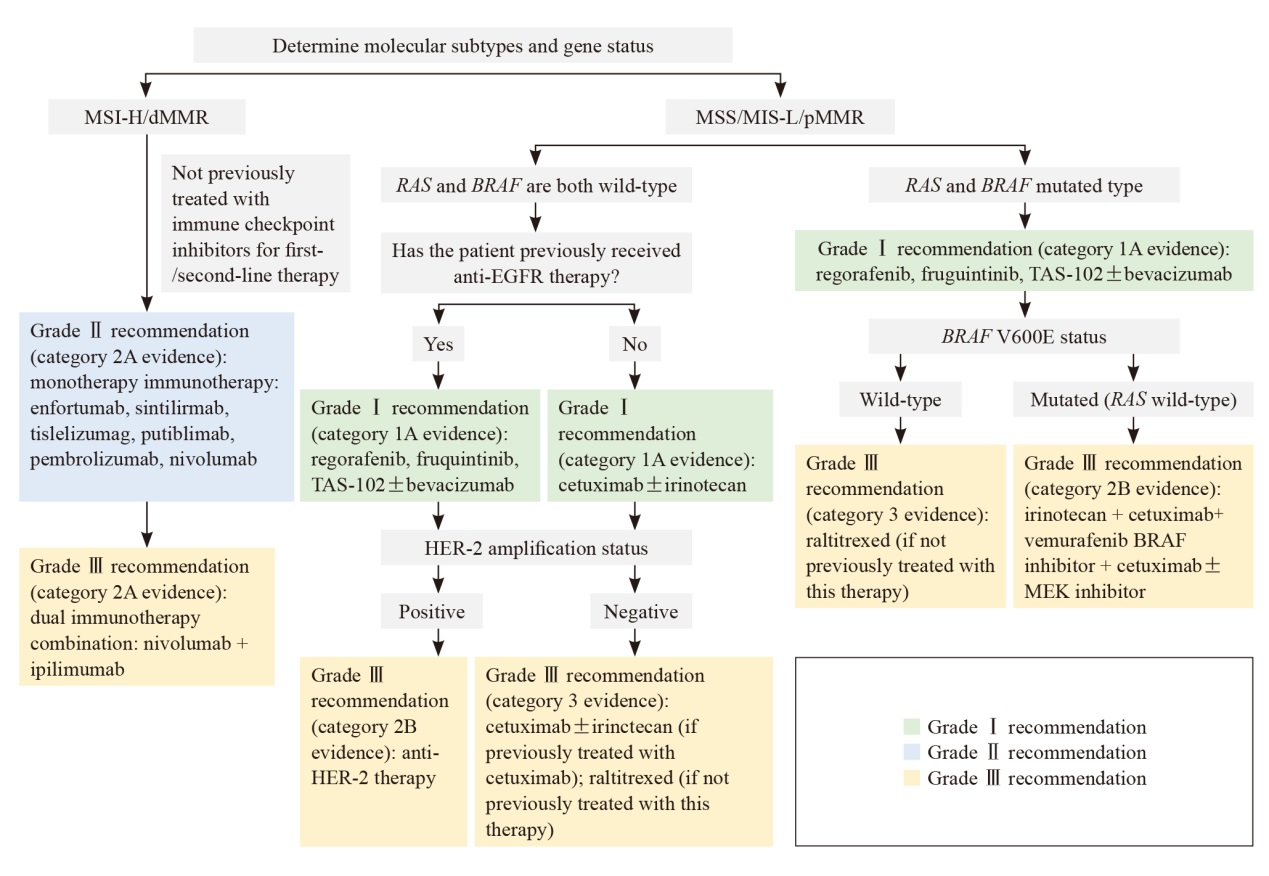
图1
个体化治疗分层流程图:基于分子分型、基因状态及既往治疗史的mCRC三线个体化治疗的流程分层"
| [1] |
DEKKER E, TANIS P J, VLEUGELS J L A, et al. Colorectal cancer[J]. Lancet, 2019, 394(10207): 1467-1480.
doi: S0140-6736(19)32319-0 pmid: 31631858 |
| [2] |
YOSHINO T, CERVANTES A, BANDO H, et al. Pan-Asian adapted ESMO clinical practice guidelines for the diagnosis, treatment and follow-up of patients with metastatic colorectal cancer[J]. ESMO open, 2023, 8(3): 101558.
doi: 10.1016/j.esmoop.2023.101558 |
| [3] |
SAINI K S, TWELVES C. Determining lines of therapy in patients with solid cancers: a proposed new systematic and comprehensive framework[J]. Br J Cancer, 2021, 125(2): 155-163.
doi: 10.1038/s41416-021-01319-8 |
| [4] | DENG T, DUAN J J, BAI M, et al. Third-line treatment patterns and clinical outcomes for metastatic colorectal cancer: a retrospective real-world study[J]. Ther Adv Chronic Dis, 2023, 14: 20406223231197311. |
| [5] |
GROTHEY A, VAN CUTSEM E, SOBRERO A, et al. Regorafenib monotherapy for previously treated metastatic colorectal cancer (CORRECT): an international, multicentre, randomised, placebo-controlled, phase 3 trial[J]. Lancet, 2013, 381(9863): 303-312.
doi: 10.1016/S0140-6736(12)61900-X pmid: 23177514 |
| [6] |
MAYER R J, VAN CUTSEM E, FALCONE A, et al. Randomized trial of TAS-102 for refractory metastatic colorectal cancer[J]. N Engl J Med, 2015, 372(20): 1909-1919.
doi: 10.1056/NEJMoa1414325 |
| [7] |
LI J, QIN S K, XU R H, et al. Effect of fruquintinib vs placebo on overall survival in patients with previously treated metastatic colorectal cancer: the FRESCO randomized clinical trial[J]. JAMA, 2018, 319(24): 2486-2496.
doi: 10.1001/jama.2018.7855 |
| [8] |
DASARI A, LONARDI S, GARCIA-CARBONERO R, et al. Fruquintinib versus placebo in patients with refractory metastatic colorectal cancer (FRESCO-2): an international, multicentre, randomised, double-blind, phase 3 study[J]. Lancet, 2023, 402(10395): 41-53.
doi: 10.1016/S0140-6736(23)00772-9 pmid: 37331369 |
| [9] | NAPOLITANO S, MARTINI G, CIARDIELLO D, et al. Targeting the EGFR signalling pathway in metastatic colorectal cancer[J]. Lancet Gastroenterol Hepatol, 2024, 9(7): 664-676. |
| [10] |
CIARDIELLO F, TORTORA G. EGFR antagonists in cancer treatment[J]. N Engl J Med, 2008, 358(11): 1160-1174.
doi: 10.1056/NEJMra0707704 |
| [11] |
KARAPETIS C S, KHAMBATA-FORD S, JONKER D J, et al. K-ras mutations and benefit from cetuximab in advanced colorectal cancer[J]. N Engl J Med, 2008, 359(17): 1757-1765.
doi: 10.1056/NEJMoa0804385 |
| [12] |
GROTHEY A, FAKIH M, TABERNERO J. Management of BRAF-mutant metastatic colorectal cancer: a review of treatment options and evidence-based guidelines[J]. Ann Oncol, 2021, 32(8): 959-967.
doi: 10.1016/j.annonc.2021.03.206 |
| [13] |
BARRAS D, MISSIAGLIA E, WIRAPATI P, et al. BRAF V600E mutant colorectal cancer subtypes based on gene expression[J]. Clin Cancer Res, 2017, 23(1): 104-115.
doi: 10.1158/1078-0432.CCR-16-0140 |
| [14] |
DI NICOLANTONIO F, MARTINI M, MOLINARI F, et al. Wild-type BRAF is required for response to panitumumab or cetuximab in metastatic colorectal cancer[J]. J Clin Oncol, 2008, 26(35): 5705-5712.
doi: 10.1200/JCO.2008.18.0786 |
| [15] |
MARTIN V, LANDI L, MOLINARI F, et al. HER2 gene copy number status may influence clinical efficacy to anti-EGFR monoclonal antibodies in metastatic colorectal cancer patients[J]. Br J Cancer, 2013, 108(3): 668-675.
doi: 10.1038/bjc.2013.4 |
| [16] |
DAY F L, JORISSEN R N, LIPTON L, et al. PIK3CA and PTEN gene and exon mutation-specific clinicopathologic and molecular associations in colorectal cancer[J]. Clin Cancer Res, 2013, 19(12): 3285-3296.
doi: 10.1158/1078-0432.CCR-12-3614 |
| [17] |
MISALE S, DI NICOLANTONIO F, SARTORE-BIANCHI A, et al. Resistance to anti-EGFR therapy in colorectal cancer: from heterogeneity to convergent evolution[J]. Cancer Discov, 2014, 4(11): 1269-1280.
doi: 10.1158/2159-8290.CD-14-0462 pmid: 25293556 |
| [18] |
PARSEGHIAN C M, LOREE J M, MORRIS V K, et al. Anti-EGFR-resistant clones decay exponentially after progression: implications for anti-EGFR re-challenge[J]. Ann Oncol, 2019, 30(2): 243-249.
doi: S0923-7534(19)31024-5 pmid: 31987421 |
| [19] |
SHEN L, LI Q, WANG W, et al. Treatment patterns and direct medical costs of metastatic colorectal cancer patients: a retrospective study of electronic medical records from urban China[J]. J Med Econ, 2020, 23(5): 456-463.
doi: 10.1080/13696998.2020.1717500 pmid: 31950863 |
| [20] |
MARTINELLI E, MARTINI G, FAMIGLIETTI V, et al. Cetuximab rechallenge plus avelumab in pretreated patients with RAS wild-type metastatic colorectal cancer: the phase 2 single-arm clinical CAVE trial[J]. JAMA Oncol, 2021, 7(10): 1529-1535.
doi: 10.1001/jamaoncol.2021.2915 |
| [21] |
NAPOLITANO S, DE FALCO V, MARTINI G, et al. Panitumumab plus trifluridine-tipiracil as anti-epidermal growth factor receptor rechallenge therapy for refractory RAS wild-type metastatic colorectal cancer: a phase 2 randomized clinical trial[J]. JAMA Oncol, 2023, 9(7): 966-970.
doi: 10.1001/jamaoncol.2023.0655 |
| [22] |
QUAN M, CHEN J D, CHEN Z Q, et al. China special issue on gastrointestinal tumors-Cetuximab retreatment plus camrelizumab and liposomal irinotecan in patients with RAS wild-type metastatic colorectal cancer: cohort B of the phase Ⅱ CRACK study[J]. Int J Cancer, 2023, 153(11): 1877-1884.
doi: 10.1002/ijc.v153.11 |
| [23] | MONTAGUT C. Circulating tumor (ct) DNA-guided anti-EGFR rechallenge strategy in metastatic colorectal cancer (mCRC): final results of the phase Ⅱ randomized CITRIC trial[C]. ESMO Congress: Barcelona, 2024: abstract LBA33. |
| [24] |
BILLER L H, SCHRAG D. Diagnosis and treatment of metastatic colorectal cancer: a review[J]. JAMA, 2021, 325(7): 669-685.
doi: 10.1001/jama.2021.0106 pmid: 33591350 |
| [25] |
PHAM H, DIXON E. Integration of next-generation sequencing in the surgical management of colorectal liver metastasis[J]. Ann Surg Oncol, 2023, 30(11): 6815-6823.
doi: 10.1245/s10434-023-13750-7 pmid: 37316745 |
| [26] | KOPETZ S, GUTHRIE K A, MORRIS V K, et al. Randomized trial of irinotecan and cetuximab with or without vemurafenib in BRAF-mutant metastatic colorectal cancer (SWOG S1406)[J]. J Clin Oncol, 2021, 39(4): 285-294. |
| [27] | TABERNERO J, GROTHEY A, VAN CUTSEM E, et al. Encorafenib plus cetuximab as a new standard of care for previously treated BRAF V600E-mutant metastatic colorectal cancer: updated survival results and subgroup analyses from the BEACON study[J]. J Clin Oncol, 2021, 39(4): 273-284. |
| [28] |
GERMANI M M, VETERE G, SANTAMARIA F, et al. Treatment of patients with BRAF V600E-mutated metastatic colorectal cancer after progression to encorafenib and cetuximab: data from a real-world nationwide dataset[J]. ESMO Open, 2024, 9(4): 102996.
doi: 10.1016/j.esmoop.2024.102996 |
| [29] |
YAEGER R, UBOHA N V, PELSTER M S, et al. Efficacy and safety of adagrasib plus cetuximab in patients with KRAS G12C-mutated metastatic colorectal cancer[J]. Cancer Discov, 2024, 14(6): 982-993.
doi: 10.1158/2159-8290.CD-24-0217 |
| [30] |
RAGHAV K P S, MOASSER M M. Molecular pathways and mechanisms of HER2 in cancer therapy[J]. Clin Cancer Res, 2023, 29(13): 2351-2361.
doi: 10.1158/1078-0432.CCR-22-0283 |
| [31] |
SARTORE-BIANCHI A, TRUSOLINO L, MARTINO C, et al. Dual-targeted therapy with trastuzumab and lapatinib in treatment-refractory, KRAS codon 12/13 wild-type, HER2-positive metastatic colorectal cancer (HERACLES): a proof-of-concept, multicentre, open-label, phase 2 trial[J]. Lancet Oncol, 2016, 17(6): 738-746.
doi: 10.1016/S1470-2045(16)00150-9 |
| [32] |
SIENA S, DI BARTOLOMEO M, RAGHAV K, et al. Trastuzumab deruxtecan (DS-8201) in patients with HER2-expressing metastatic colorectal cancer (DESTINY-CRC01): a multicentre, open-label, phase 2 trial[J]. Lancet Oncol, 2021, 22(6): 779-789.
doi: 10.1016/S1470-2045(21)00086-3 pmid: 33961795 |
| [33] |
RAGHAV K, SIENA S, TAKASHIMA A, et al. Trastuzumab deruxtecan in patients with HER2-positive advanced colorectal cancer (DESTINY-CRC02): primary results from a multicentre, randomised, phase 2 trial[J]. Lancet Oncol, 2024, 25(9): 1147-1162.
doi: 10.1016/S1470-2045(24)00380-2 pmid: 39116902 |
| [34] |
STRICKLER J H, CERCEK A, SIENA S, et al. Tucatinib plus trastuzumab for chemotherapy-refractory, HER2-positive, RAS wild-type unresectable or metastatic colorectal cancer (MOUNTAINEER): a multicentre, open-label, phase 2 study[J]. Lancet Oncol, 2023, 24(5): 496-508.
doi: 10.1016/S1470-2045(23)00150-X |
| [35] |
SPIEKMAN I A C, ZEVERIJN L J, GEURTS B S, et al. Trastuzumab plus pertuzumab for HER2-amplified advanced colorectal cancer: results from the drug rediscovery protocol (DRUP)[J]. Eur J Cancer, 2024, 202: 113988.
doi: 10.1016/j.ejca.2024.113988 |
| [36] |
STRICKLER J H, YOSHINO T, GRAHAM R P, et al. Diagnosis and treatment of ERBB2-positive metastatic colorectal cancer: A review[J]. JAMA Oncol, 2022, 8(5): 760-769.
doi: 10.1001/jamaoncol.2021.8196 pmid: 35238866 |
| [37] |
ZHU G M, PEI L J, XIA H W, et al. Role of oncogenic KRAS in the prognosis, diagnosis and treatment of colorectal cancer[J]. Mol Cancer, 2021, 20(1): 143.
doi: 10.1186/s12943-021-01441-4 |
| [38] |
CANON J, REX K, SAIKI A Y, et al. The clinical KRAS (G12C) inhibitor AMG 510 drives anti-tumour immunity[J]. Nature, 2019, 575(7781): 217-223.
doi: 10.1038/s41586-019-1694-1 |
| [39] |
FAKIH M G, KOPETZ S, KUBOKI Y, et al. Sotorasib for previously treated colorectal cancers with KRAS G12C mutation (CodeBreaK100): a prespecified analysis of a single-arm, phase 2 trial[J]. Lancet Oncol, 2022, 23(1): 115-124.
doi: 10.1016/S1470-2045(21)00605-7 |
| [40] | OU S I, JÄNNE P A, LEAL T A, et al. First-in-human phase Ⅰ/ⅠB dose-finding study of adagrasib (MRTX849) in patients with advanced KRAS G12C solid tumors (KRYSTAL-1)[J]. J Clin Oncol, 2022, 40(23): 2530-2538. |
| [41] |
YAEGER R, MEZZADRA R, SINOPOLI J, et al. Molecular characterization of acquired resistance to KRAS G12C-EGFR inhibition in colorectal cancer[J]. Cancer Discov, 2023, 13(1): 41-55.
doi: 10.1158/2159-8290.CD-22-0405 |
| [42] |
KUBOKI Y, FAKIH M, STRICKLER J, et al. Sotorasib with panitumumab in chemotherapy-refractory KRASG12C-mutated colorectal cancer: a phase 1b trial[J]. Nat Med, 2024, 30(1): 265-270.
doi: 10.1038/s41591-023-02717-6 |
| [43] |
FAKIH M G, SALVATORE L, ESAKI T, et al. Sotorasib plus panitumumab in refractory colorectal cancer with mutated KRAS G12C[J]. N Engl J Med, 2023, 389(23): 2125-2139.
doi: 10.1056/NEJMoa2308795 |
| [44] | Chinese Society of Clinical Oncology (CSCO) Colorectal Cancer Expert Committee. CSCO guidelines for the diagnosis and treatment of colorectal cancer 2024[J]. Chin J Oncol, 2024, 30(1): 1-50. |
| [45] |
TAIEB J, SVRCEK M, COHEN R, et al. Deficient mismatch repair/microsatellite unstable colorectal cancer: diagnosis, prognosis and treatment[J]. Eur J Cancer, 2022, 175: 136-157.
doi: 10.1016/j.ejca.2022.07.020 pmid: 36115290 |
| [46] | LE D T, KIM T W, VAN CUTSEM E, et al. Phase Ⅱ open-label study of pembrolizumab in treatment-refractory, microsatellite instability-high/mismatch repair-deficient metastatic colorectal cancer: KEYNOTE-164[J]. J Clin Oncol, 2020, 38(1): 11-19. |
| [47] |
LI J, DENG Y H, ZHANG W J, et al. Subcutaneous envafolimab monotherapy in patients with advanced defective mismatch repair/microsatellite instability high solid tumors[J]. J Hematol Oncol, 2021, 14(1): 95.
doi: 10.1186/s13045-021-01095-1 |
| [48] |
ANDRÉ T, BERTON D, CURIGLIANO G, et al. Antitumor activity and safety of dostarlimab monotherapy in patients with mismatch repair deficient solid tumors: a nonrandomized controlled trial[J]. JAMA Netw Open, 2023, 6(11): e2341165.
doi: 10.1001/jamanetworkopen.2023.41165 |
| [49] | ZHANG B, SONG Y, LUO S X, et al. Pucotenlimab in patients with advanced mismatch repair-deficient or microsatellite instability-high solid tumors: a multicenter phase 2 study[J]. Cell Rep Med, 2023, 4(12): 101301. |
| [50] |
KAWAZOE A, XU R H, GARCÍA-ALFONSO P, et al. Lenvatinib plus pembrolizumab versus standard of care for previously treated metastatic colorectal cancer: final analysis of the randomized, open-label, phase Ⅲ LEAP-017 study[J]. J Clin Oncol, 2024, 42(24): 2918-2927.
doi: 10.1200/JCO.23.02736 |
| [51] | LENZ H J, VAN CUTSEM E, LUISA LIMON M, et al. First-line nivolumab plus low-dose ipilimumab for microsatellite instability-high/mismatch repair-deficient metastatic colorectal cancer: the phase Ⅱ CheckMate 142 study[J]. J Clin Oncol, 2022, 40(2): 161-170. |
| [52] |
OVERMAN M J, GELSOMINO F, AGLIETTA M, et al. Nivolumab plus relatlimab in patients with previously treated microsatellite instability-high/mismatch repair-deficient metastatic colorectal cancer: the phase Ⅱ CheckMate 142 study[J]. J Immunother Cancer, 2024, 12(5): e008689.
doi: 10.1136/jitc-2023-008689 |
| [53] |
LIZARDO D Y, KUANG C Y, HAO S S, et al. Immunotherapy efficacy on mismatch repair-deficient colorectal cancer: from bench to bedside[J]. Biochim Biophys Acta Rev Cancer, 2020, 1874(2): 188447.
doi: 10.1016/j.bbcan.2020.188447 |
| [54] |
CHEN E X, JONKER D J, LOREE J M, et al. Effect of combined immune checkpoint inhibition vs best supportive care alone in patients with advanced colorectal cancer: the Canadian cancer trials group CO.26 study[J]. JAMA Oncol, 2020, 6(6): 831-838.
doi: 10.1001/jamaoncol.2020.0910 |
| [55] |
BULLOCK A J, SCHLECHTER B L, FAKIH M G, et al. Botensilimab plus balstilimab in relapsed/refractory microsatellite stable metastatic colorectal cancer: a phase 1 trial[J]. Nat Med, 2024, 30(9): 2558-2567.
doi: 10.1038/s41591-024-03083-7 pmid: 38871975 |
| [56] |
JOHNSON B, HAYMAKER C L, PARRA E R, et al. Phase Ⅱ study of durvalumab (anti-PD-L1) and trametinib (MEKi) in microsatellite stable (MSS) metastatic colorectal cancer (mCRC)[J]. J Immunother Cancer, 2022, 10(8): e005332.
doi: 10.1136/jitc-2022-005332 |
| [57] |
SAEED A, PARK R, PATHAK H, et al. Clinical and biomarker results from a phase Ⅱ trial of combined cabozantinib and durvalumab in patients with chemotherapy-refractory colorectal cancer (CRC): CAMILLA CRC cohort[J]. Nat Commun, 2024, 15(1): 1533.
doi: 10.1038/s41467-024-45960-2 |
| [58] |
WANG F, JIN Y, WANG M, et al. Combined anti-PD-1, HDAC inhibitor and anti-VEGF for MSS/pMMR colorectal cancer: a randomized phase 2 trial[J]. Nat Med, 2024, 30(4): 1035-1043.
doi: 10.1038/s41591-024-02813-1 pmid: 38438735 |
| [59] |
SEGAL N H, MELERO I, MORENO V, et al. CEA-CD3 bispecific antibody cibisatamab with or without atezolizumab in patients with CEA-positive solid tumours: results of two multi-institutional phase 1 trials[J]. Nat Commun, 2024, 15(1): 4091.
doi: 10.1038/s41467-024-48479-8 pmid: 38750034 |
| [60] |
LEMECH C, DREDGE K, BAMPTON D, et al. Phase Ⅰb open-label, multicenter study of pixatimod, an activator of TLR9, in combination with nivolumab in subjects with microsatellite-stable metastatic colorectal cancer, metastatic pancreatic ductal adenocarcinoma and other solid tumors[J]. J Immunother Cancer, 2023, 11(1): e006136.
doi: 10.1136/jitc-2022-006136 |
| [61] |
FRENTZAS S, AUSTRIA MISLANG A R, LEMECH C, et al. Phase 1a dose escalation study of ivonescimab (AK112/SMT112), an anti-PD-1/VEGF-A bispecific antibody, in patients with advanced solid tumors[J]. J Immunother Cancer, 2024, 12(4): e008037.
doi: 10.1136/jitc-2023-008037 |
| [62] |
ZHANG P, LI X F, WANG X, et al. SHR-8068 combined with adebrelimab and bevacizumab in the treatment of refractory advanced colorectal cancer: study protocol for a single-arm, phase Ⅰb/Ⅱ study[J]. Front Immunol, 2024, 15: 1450533.
doi: 10.3389/fimmu.2024.1450533 |
| [63] |
KANN B H, HOSNY A, AERTS H J W L. Artificial intelligence for clinical oncology[J]. Cancer Cell, 2021, 39(7): 916-927.
doi: 10.1016/j.ccell.2021.04.002 pmid: 33930310 |
| [64] | BILAL M, RAZA S E A, AZAM A, et al. Development and validation of a weakly supervised deep learning framework to predict the status of molecular pathways and key mutations in colorectal cancer from routine histology images: a retrospective study[J]. Lancet Digit Health, 2021, 3(12): e763-e772. |
| [65] |
MARTINI G, CIARDIELLO D, DALLIO M, et al. Gut microbiota correlates with antitumor activity in patients with mCRC and NSCLC treated with cetuximab plus avelumab[J]. Int J Cancer, 2022, 151(3): 473-480.
doi: 10.1002/ijc.34033 pmid: 35429341 |
| [66] |
VÉTIZOU M, PITT J M, DAILLÈRE R, et al. Anticancer immunotherapy by CTLA-4 blockade relies on the gut microbiota[J]. Science, 2015, 350(6264): 1079-1084.
doi: 10.1126/science.aad1329 pmid: 26541610 |
| [67] |
GOPALAKRISHNAN V, SPENCER C N, NEZI L, et al. Gut microbiome modulates response to anti-PD-1 immunotherapy in melanoma patients[J]. Science, 2018, 359(6371): 97-103.
doi: 10.1126/science.aan4236 pmid: 29097493 |
| [68] |
ROUTY B, LE CHATELIER E, DEROSA L, et al. Gut microbiome influences efficacy of PD-1-based immunotherapy against epithelial tumors[J]. Science, 2018, 359(6371): 91-97.
doi: 10.1126/science.aan3706 pmid: 29097494 |
| [69] |
XU X J, LV J, GUO F, et al. Gut microbiome influences the efficacy of PD-1 antibody immunotherapy on MSS-type colorectal cancer via metabolic pathway[J]. Front Microbiol, 2020, 11: 814.
doi: 10.3389/fmicb.2020.00814 |
| [70] |
WONG C C, YU J. Gut microbiota in colorectal cancer development and therapy[J]. Nat Rev Clin Oncol, 2023, 20(7): 429-452.
doi: 10.1038/s41571-023-00766-x pmid: 37169888 |
| [71] |
BARUCH E N, YOUNGSTER I, BEN-BETZALEL G, et al. Fecal microbiota transplant promotes response in immunotherapy-refractory melanoma patients[J]. Science, 2021, 371(6529): 602-609.
doi: 10.1126/science.abb5920 pmid: 33303685 |
| [72] |
DAVAR D, DZUTSEV A K, MCCULLOCH J A, et al. Fecal microbiota transplant overcomes resistance to anti-PD-1 therapy in melanoma patients[J]. Science, 2021, 371(6529): 595-602.
doi: 10.1126/science.abf3363 pmid: 33542131 |
| [73] |
MICHAUX A, MAUËN S, BREMAN E, et al. Clinical grade manufacture of CYAD-101, a NKG2D-based, first in class, non-gene-edited allogeneic CAR T-cell therapy[J]. J Immunother, 2022, 45(3): 150-161.
doi: 10.1097/CJI.0000000000000413 pmid: 35191428 |
| [74] |
CHEN N F, PU C F, ZHAO L L, et al. Chimeric antigen receptor T cells targeting CD19 and GCC in metastatic colorectal cancer: a nonrandomized clinical trial[J]. JAMA Oncol, 2024, 10(11): 1532-1536.
doi: 10.1001/jamaoncol.2024.3891 |
| [1] | 张钰洋, 刘骞. 结直肠癌新辅助免疫治疗的进展与展望[J]. 中国癌症杂志, 2025, 35(7): 642-656. |
| [2] | 安杨, 王晨童, 邱小原, 周皎琳, 林国乐. 局部进展期直肠癌新辅助免疫治疗免疫相关不良反应的临床管理及分析[J]. 中国癌症杂志, 2025, 35(7): 665-671. |
| [3] | 杜可为, 张尚弟, 胡文飞, 高山, 甘建新, 尤崇革. 基于血清蛋白质组学的TAGLN2、CTSD等5种早期胃癌生物标志物的发现及初步验证[J]. 中国癌症杂志, 2025, 35(6): 543-554. |
| [4] | 范素梅, 信聪伶, 朱来芳, 刘畅, 徐蕊, 周正荣, 程玺. 卡瑞利珠单抗联合化疗及靶向治疗在复发、转移及初治晚期宫颈癌中的疗效与安全性分析:一项回顾性队列研究[J]. 中国癌症杂志, 2025, 35(6): 570-577. |
| [5] | 李浩, 邓瑾, 刘沛华, 张泉涌, 蔡寨. 食管胃结合部腺癌皮肤转移1例报道及疗效分析[J]. 中国癌症杂志, 2025, 35(6): 601-604. |
| [6] | 邓绮玲, 宋迪, 奚可欣, 谢晓婷, 吴小延, 赵卫. 血浆游离DNA检测对非小细胞肺癌靶向治疗相关基因筛选及患者预后预测的研究[J]. 中国癌症杂志, 2025, 35(4): 355-364. |
| [7] | 李彬, 陶中华, 胡夕春. CDK4/6抑制剂后时代下的乳腺癌精准诊疗[J]. 中国癌症杂志, 2025, 35(3): 273-282. |
| [8] | 赵锴乐, 王磊, 耿健雄, 崔成伟, 于雁. 恶性胸膜间皮瘤治疗的研究现状与展望[J]. 中国癌症杂志, 2025, 35(3): 326-332. |
| [9] | 卢愚风, 王晗, 谢亦璠, 江一舟, 邵志敏. 中国乳腺癌重要基础转化研究——进展与展望[J]. 中国癌症杂志, 2025, 35(2): 143-153. |
| [10] | 林佳琳, 王文娜, 徐兵河. 抗体药物偶联物在乳腺癌领域的研究现状与展望[J]. 中国癌症杂志, 2025, 35(2): 154-166. |
| [11] | 郭晔, 胡超苏, 张陈平. 局部晚期头颈部鳞状细胞癌免疫治疗MDT专家共识(2025年版)[J]. 中国癌症杂志, 2025, 35(11): 1076-1089. |
| [12] | 刘浩, 苏俊杰, 辛士永. MYC通过靶向CD47促进前列腺癌增殖和转移的机制研究[J]. 中国癌症杂志, 2025, 35(11): 987-1000. |
| [13] | 杨舒雯, 季冬梅, 王宇. 晚期分化型甲状腺癌系统治疗的10年演进:2015与2025年版ATA指南对比分析[J]. 中国癌症杂志, 2025, 35(10): 935-940. |
| [14] | 耿倩倩, 杨爱民. 碘难治性分化型甲状腺癌的治疗进展及展望[J]. 中国癌症杂志, 2025, 35(1): 30-39. |
| [15] | 李汝平, 杨辉. 放射性碘难治性甲状腺癌的临床试验现状及未来展望[J]. 中国癌症杂志, 2025, 35(1): 40-48. |
| 阅读次数 | ||||||
|
全文 |
|
|||||
|
摘要 |
|
|||||
地址:上海市徐汇区东安路270号复旦大学附属肿瘤医院10号楼415室
邮编:200032 电话:021-64188274 E-mail:zgazzz@china-oncology.com
访问总数:; 今日访问总数:; 当前在线人数:
本系统由北京玛格泰克科技发展有限公司设计开发 技术支持:support@magtech.com.cn

