Welcome to China Oncology,
China Oncology ›› 2025, Vol. 35 ›› Issue (11): 1041-1048.doi: 10.19401/j.cnki.1007-3639.2025.11.006
• Article • Previous Articles Next Articles
LIU Miaomiao( ), HUANG Yushan, YANG Guozi, TAI Panpan, CHEN Xiao, LIU Min, PAN Zhenyu()(
 )
)
Received:2025-06-12
Revised:2025-07-12
Online:2025-11-30
Published:2025-12-12
Contact:
PAN Zhenyu
E-mail:dr-zypan@163.com
Supported by:Share article
CLC Number:
LIU Miaomiao, HUANG Yushan, YANG Guozi, TAI Panpan, CHEN Xiao, LIU Min, PAN Zhenyu. Phase Ⅰ study of intrathecal pemetrexed combined with programmed death-1 inhibitor for leptomeningeal metastases from solid tumors[J]. China Oncology, 2025, 35(11): 1041-1048.
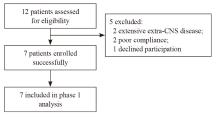
Fig. 1
Flowchart of patients inclusion and exclusion criteria"

Tab. 1
Basic characteristics of patients and treatment details"
| No. | Gender | Age/year | Primary tumor type | Molecular Characteristic | CPS/TPS | Prior systematic treatment | Extraneural lesions at enrollment |
|---|---|---|---|---|---|---|---|
| P1 | Female | 41 | Breast cancer | HER2 3+ | NA | Chemotherapy, targeted therapy | Stable |
| P2 | Female | 53 | Lung adenocarcinoma | 21L858R | NA | Gefitinib, almonertinib, chemotherapy | Stable |
| P3 | Male | 59 | Lung adenocarcinoma | KRAS Exon-2G12C | 3% | Sotorasib | Stable |
| P4 | Male | 58 | Lung adenocarcinoma | 21 L858R | 0% | Chemotherapy, icotinib, osimertinib (80, 160 mg), furmonertinib (160 mg) | Stable |
| P5 | Female | 60 | Lung adenocarcinoma | 21L858R | 0% | Icotinib, erlotinib, osimertinib (80 mg), chemotherapy | Stable |
| P6 | Male | 62 | Lung adenocarcinoma | 21L858R | 98% | Chemotherapy, gefitinib, almonertinib (110 mg), furmonertinib (80 mg) | Stable |
| P7 | Female | 54 | Lung adenocarcinoma | 21L858R | 0% | Furmonertinib (80, 160 mg), chemotherapy, osimertinib (160 mg) | Stable |
| No. | KPS | Symptom | Sign | Imaging | Cytology | Previous treatment related to LM | |
| P1 | 70 | Headache | Hypoesthesia, abnormal gait | Linear and nodular enhancement | Positive | none | |
| P2 | 50 | Dizziness, headache, vomiting | Bilateral blindness | Linear and nodular enhancement | Positive | none | |
| P3 | 70 | Dizziness, headache | Decreased hearing, decreased vision | Linear enhancement | Positive | none | |
| P4 | 70 | Dizziness | Hypoesthesia, decreased hearing, decreased muscle strength | Linear enhancement | Positive | none | |
| P5 | 70 | Headache, nausea, vomiting | none | none | Positive | none | |
| P6 | 60 | Dizziness, headache | Hypoesthesia, abnormal gait, decreased muscle strength | Linear and nodular enhancement | Positive | Intrathecal methotrexate 10 times | |
| P7 | 60 | Dizziness, headache, nausea, vomiting | Blurred vision, decreased muscle strength | none | Positive | none | |
Tab. 2
Treatment-related adverse events during therapy"
| No. | Timepoint of adverse events occurrence | Adverse events and grading | Treatment |
|---|---|---|---|
| P1 | After the 3rd IP; After the 6th IP; After the 11th IP | Grade 3 hematologic toxicity; Grade 1 EHA; Grade 2 hypothyroidism | Leukocyte and platelet elevation therapy; Hepatoprotective therapy; Levothyroxine tablet replacement therapy |
| P2 | After the 3rd IP; After the 3rd IP | Grade 1 hematologic toxicity; Grade 1 EHA | Leukocyte elevation therapy; Hepatoprotective therapy |
| P3 | After the 6th IP | Grade 1 hematologic toxicity | Iron supplementation |
| P4 | After the 6th IP | Grade 1hematologic toxicity | Leukocyte elevation therapy |
| P5 | After the 4th IP; After the 4th IP; After the 7th IP | Grade 3 hematologic toxicity; Grade 2 fatigue; Grade 1 EHA | Leukocyte and platelet elevation therapy; None; Hepatoprotective therapy |
| P6 | After the 4th IP; After the 7th IP | Grade 3 hematologic toxicity; Bacterial meningitis | Leukocyte and platelet elevation therapy; Suspend intrathecal injection, initiate antibacterial therapy |
| P7 | After the 4th IP; After the 6th IP | Grade 2 fatigue; Grade 1 hematologic toxicity | None; Iron supplementation |
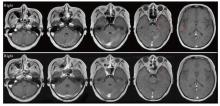
Fig. 2
Comparison of brain magnetic resonance imaging before and after treatment in the first patient Red markings indicate lesions that have regressed or disappeared outside the irradiation field."
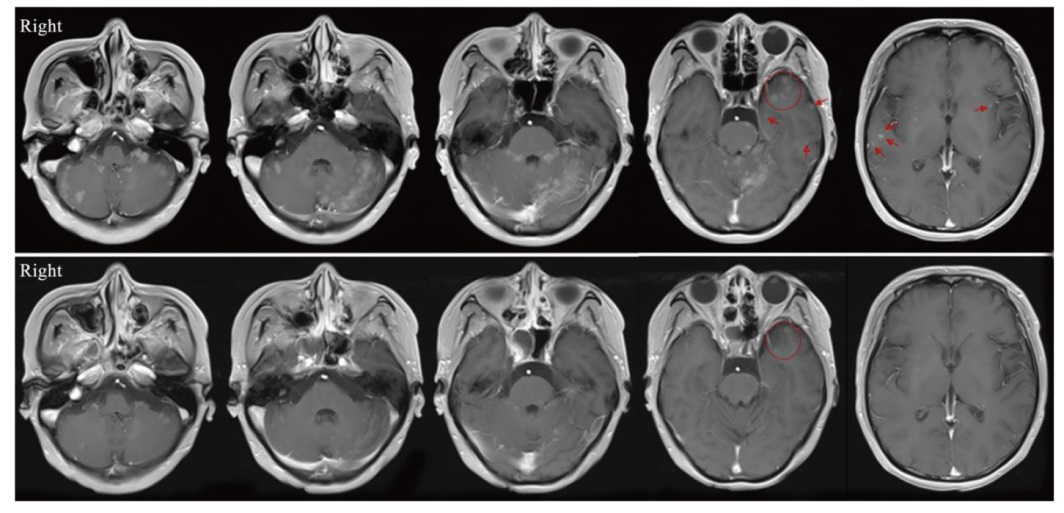
Fig. 3
Comparison of mediastinal lymph nodes before and after treatment in the third patient"
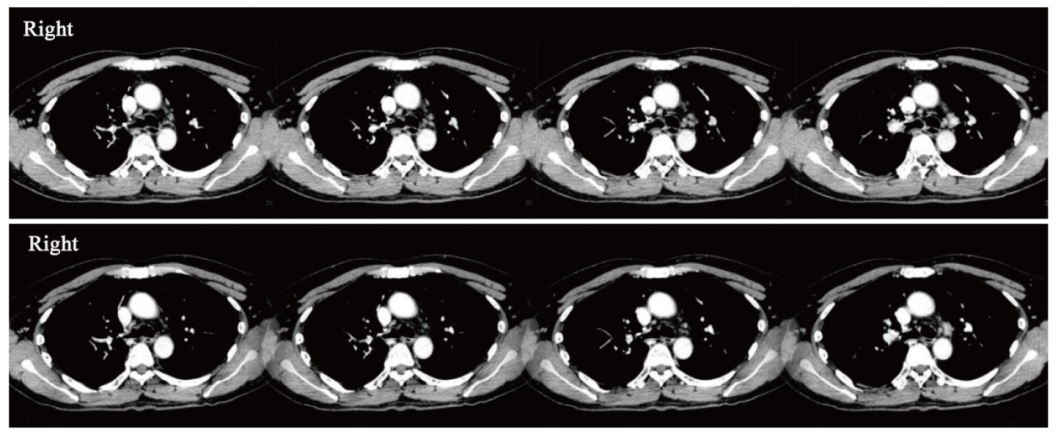
Fig. 4
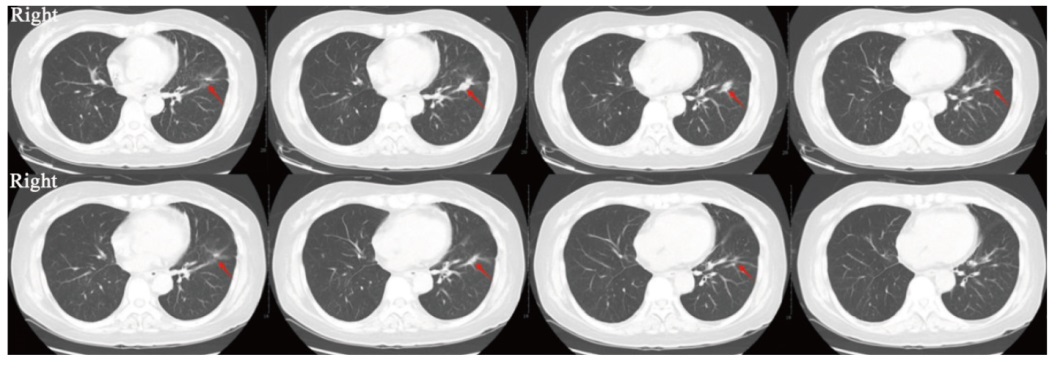
Comparison of primary lung lesions before and after treatment in the fifth patient The red arrow indicates the regressed primary lung lesion."
Tab. 3
Efficacy evaluation after induction and consolidation therapy"
| No. | Number of intrathecal injections | Concurrent treatment during trial participation | CSF cytological | Symptom | Imaging | Signs | Outcome | Survival time/month | Follow-up status | |||
|---|---|---|---|---|---|---|---|---|---|---|---|---|
| IT-P | IT-PD-1 | Before treatment | after treatment | NRT | RT | |||||||
| P1 | 15 | 10 | Local LM and BM RT | + | - | Improved | Improved | Improved | Improved | Response | 9.3 | Under follow-up |
| P2 | 12 | 7 | none | + | + | Improved | Stable | NA | Stable | Stable | 5.9 | Died |
| P3 | 14 | 9 | Partial spine RT | + | + | Stable | Stable | Stable | Stable | Stable | 8.1 | Under follow-up |
| P4 | 12 | 7 | None | + | + | Improved | Stable | NA | Improved | Response | 7.7 | Under follow-up |
| P5 | 13 | 7 | Partial spine RT | + | + | Improved | Stable | Stable | Stable | Stable | 7.3 | Under follow-up |
| P6 | 12 | 4 | Partial spine RT | + | + | Improved | Stable | Improved | Stable | Response* | 8.3 | Under follow-up |
| P7 | 14 | 7 | None | + | + | Improved | Stable | NA | Improved | Response | 6.3 | Under follow-up |
| [1] |
REMSIK J, BOIRE A. The path to leptomeningeal metastasis[J]. Nat Rev Cancer, 2024, 24(7): 448-460.
doi: 10.1038/s41568-024-00700-y pmid: 38871881 |
| [2] |
PAN Z Y, YANG G Z, CUI J W, et al. A pilot phase 1 study of intrathecal pemetrexed for refractory leptomeningeal metastases from non-small-cell lung cancer[J]. Front Oncol, 2019, 9: 838.
doi: 10.3389/fonc.2019.00838 pmid: 31544065 |
| [3] |
MEYER M L, FITZGERALD B G, PAZ-ARES L, et al. New promises and challenges in the treatment of advanced non-small-cell lung cancer[J]. Lancet, 2024, 404(10454): 803-822.
doi: 10.1016/S0140-6736(24)01029-8 |
| [4] | PATEL K K, HASSAN D, NAIR S, et al. Role of immunotherapy in the treatment of triple-negative breast cancer: a literature review[J]. Cureus, 2022, 14(11): e31729. |
| [5] |
DHANYAMRAJU P K, PATEL T N. Melanoma therapeutics: a literature review[J]. J Biomed Res, 2022, 36(2): 77-97.
doi: 10.7555/JBR.36.20210163 pmid: 35260531 |
| [6] |
NAIDOO J, SCHRECK K C, FU W, et al. Pembrolizumab for patients with leptomeningeal metastasis from solid tumors: efficacy, safety, and cerebrospinal fluid biomarkers[J]. J Immunother Cancer, 2021, 9(8): e002473.
doi: 10.1136/jitc-2021-002473 |
| [7] |
BRASTIANOS P K, LEE E Q, COHEN J V, et al. Single-arm, open-label phase 2 trial of pembrolizumab in patients with leptomeningeal carcinomatosis[J]. Nat Med, 2020, 26(8): 1280-1284.
doi: 10.1038/s41591-020-0918-0 pmid: 32483359 |
| [8] |
BRASTIANOS P K, STRICKLAND M R, LEE E Q, et al. Phase Ⅱ study of ipilimumab and nivolumab in leptomeningeal carcinomatosis[J]. Nat Commun, 2021, 12: 5954.
doi: 10.1038/s41467-021-25859-y |
| [9] |
PLUIM D, ROS W, VAN BUSSEL M T J, et al. Enzyme linked immunosorbent assay for the quantification of nivolumab and pembrolizumab in human serum and cerebrospinal fluid[J]. J Pharm Biomed Anal, 2019, 164: 128-134.
doi: S0731-7085(18)30375-3 pmid: 30368118 |
| [10] |
GLITZA OLIVA I C, FERGUSON S D, BASSETT R JR, et al. Concurrent intrathecal and intravenous nivolumab in leptomeningeal disease: phase 1 trial interim results[J]. Nat Med, 2023, 29(4): 898-905.
doi: 10.1038/s41591-022-02170-x pmid: 36997799 |
| [11] | PAN Z, YANG G, WANG Z, et al. OS09.6.A a multicenter, phase Ⅰ/Ⅱ, open-label study of intrathecal pemetrexed for leptomeningeal metastases from solid tumor (PMLM, NCT05289908)[J]. J Neuro-Oncol, 2023, 25(suppl_2): ii21-ii22. |
| [12] | PAN Z Y, YANG G Z, HE H, et al. Intrathecal pemetrexed combined with involved-field radiotherapy as a first-line intra-CSF therapy for leptomeningeal metastases from solid tumors: a phase Ⅰ/Ⅱ study[J]. Ther Adv Med Oncol, 2020, 12: 1758835920937953. |
| [13] | 潘振宇, 宋媛媛, 姜同超, 等. 培美曲塞鞘内化疗治疗实体肿瘤脑膜转移的临床研究[J]. 中华肿瘤杂志, 2022, 44(1) : 112-119. |
| PAN Z Y, SONG Y Y, JIANG T C, et al. Clinical trials on intrathecal pemetrexed treated leptomeningeal metastases from solid tumors[J]. Chin J Oncol, 2022, 44(1): 112-119. | |
| [14] | 潘振宇, 李思佳, 王卓, 等. 培美曲塞鞘内化疗治疗实体瘤脑膜转移Ⅰ期研究[J] 中华转移性肿瘤杂志, 2024, 7(5): 456-462. |
| PAN Z Y, LI S J, WANG Z, et al. A phase Ⅰ dose-escalation study of pemetrexed intrathecal chemotherapy for leptomeningeal metastasis of solid tumors[J]. Chin J Metast Cancer, 2024, 7(5): 456-462. | |
| [15] |
YANG J C H, KIM S W, KIM D W, et al. Osimertinib in patients with epidermal growth factor receptor mutation-positive non-small-cell lung cancer and leptomeningeal metastases: the BLOOM study[J]. J Clin Oncol, 2020, 38(6): 538-547.
doi: 10.1200/JCO.19.00457 pmid: 31809241 |
| [16] |
PARK S, BALDRY R, JUNG H A, et al. Phase Ⅱ efficacy and safety of 80 mg osimertinib in patients with leptomeningeal metastases associated with epidermal growth factor receptor mutation-positive non-small cell lung cancer (BLOSSOM)[J]. J Clin Oncol, 2024, 42(23): 2747-2756.
doi: 10.1200/JCO.24.00708 |
| [17] |
XU Z Y, HAO X Z, WANG Q, et al. Intracranial efficacy and safety of furmonertinib 160 mg with or without anti-angiogenic agent in advanced NSCLC patients with BM/LM as salvage therapy[J]. BMC Cancer, 2023, 23(1): 206.
doi: 10.1186/s12885-023-10676-x |
| [18] |
AHN M J, KIM D W, CHO B C, et al. Activity and safety of AZD3759 in EGFR-mutant non-small-cell lung cancer with CNS metastases (BLOOM): a phase 1, open-label, dose-escalation and dose-expansion study[J]. Lancet Respir Med, 2017, 5(11): 891-902.
doi: 10.1016/S2213-2600(17)30378-8 |
| [19] |
RODRÍGUEZ-RUIZ M E, VANPOUILLE-BOX C, MELERO I, et al. Immunological mechanisms responsible for radiation-induced abscopal effect[J]. Trends Immunol, 2018, 39(8): 644-655.
doi: 10.1016/j.it.2018.06.001 |
| [20] |
DEMARIA S, NG B, DEVITT M L, et al. Ionizing radiation inhibition of distant untreated tumors (abscopal effect) is immune mediated[J]. Int J Radiat Oncol Biol Phys, 2004, 58(3): 862-870.
doi: 10.1016/j.ijrobp.2003.09.012 |
| [21] |
LIU J, WEST H, MCGEE H M, et al. Challenges in synergizing radiotherapy with immunotherapy to unlock the abscopal effect in metastatic NSCLC: a systematic review[J]. Neoplasia, 2023, 43: 100914.
doi: 10.1016/j.neo.2023.100914 |
| [22] |
PEVZNER A M, TSYGANOV M M, IBRAGIMOVA M K, et al. Abscopal effect in the radio and immunotherapy[J]. Radiat Oncol J, 2021, 39(4): 247-253.
doi: 10.3857/roj.2021.00115 pmid: 34986545 |
| [1] | Multiple Primary and Unknown Primary Tumors Special Committee of China Anti-Cancer Association , Shanghai Anti Cancer Association Multiple Primary and Unknown Primary Tumor Special Committee , Lymphocytic Disease Group, Hematology Branch, Chinese Medical Association , Rare Disease Group, Hematology Branch, Chinese Medical Association . Expert consensus on diagnosis and treatment of hematologic malignancies with solid tumors (2025 version) [J]. China Oncology, 2025, 35(10): 968-986. |
| [2] | HUANG Sijie, KANG Xun, LI Wenbin. Clinical research progress of intrathecal therapy in the treatment of leptomeningeal metastasis [J]. China Oncology, 2024, 34(7): 695-701. |
| [3] | ZHENG Weitao, LI Hanluo, HU Kanghong. TCR-T immunotherapy for the treatment of solid tumor: current status, challenges and future prospects [J]. China Oncology, 2023, 33(7): 707-716. |
| [4] | LI Ting, XU Yu, JIA Dongdong, LIAO Zhichao, SUN Wei, WU Haixiao, REN Zhiwu, ZHAO Jun, XING Ruwei, TENG Sheng, YANG Yun, CHEN Yong, LI Tao, YANG Jilong. Adjuvant therapy with anti-PD-1 antibody vs targeted therapy for patients with resected stage Ⅲ malignant melanoma: a real-world data analysis from China centers [J]. China Oncology, 2022, 32(12): 1147-1157. |
| [5] | SHI Maolin , BAI Yudi , WANG Chao , LI Siqi , ZHOU Daijun , PENG Jingjing , SUN Feifan , LI Dong , ZHANG Tao . Effect of PD-L1 expression on the efficacy of pemetrexed-based chemotherapy in patients with advanced lung adenocarcinoma and its mechanism [J]. China Oncology, 2021, 31(4): 308-316. |
| [6] | ZHANG Jian , SHEN Weina , JI Dongmei , WANG Leiping , GONG Chengcheng , HU Xichun . FUSCC criteria for the management of targeted drug-induced interstitial lung disease in solid tumors [J]. China Oncology, 2021, 31(4): 241-249. |
| [7] | ZHENG Xiaocui, WANG Xipeng. Progress of single-cell sequencing in solid tumors [J]. China Oncology, 2019, 29(7): 535-539. |
| [8] | LIU Hongliu, YANG Jiamei. Pemetrexed with gefitinib or pemetrexed alone in advanced non-small cell lung cancer with acquired resistance to EGFR tyrosine kinase inhibitors [J]. China Oncology, 2017, 27(2): 135-139. |
| [9] | ZHOU Juan, BEN Suqin. The clinical effects of pemetrexed or docetaxel combined with cisplatin as the first line treatment for advanced lung adenocarcinoma [J]. China Oncology, 2015, 25(9): 671-676. |
| [10] | CHEN Shu-xia, YANG Han-chao, CHEN Hong-da. Clinical observation of pemetrexed contrast to the best supportive care in the patients with advanced non-small cell lung cancer [J]. China Oncology, 2014, 24(8): 626-629. |
| [11] | CHEN Wen-yi, WANG Wei-min, JIANG Li-yan, SHI Chun-lei, XIONG Li-wen, CHU Tian-qing, PEI Jun, GU Ai-qin. Clinical observation of efficacy and safety of pemetrexed plus platinum as the first–line chemotherapy with advanced non-squamous non-small cell lung cancer [J]. China Oncology, 2014, 24(8): 610-614. |
| Viewed | ||||||
|
Full text |
|
|||||
|
Abstract |
|
|||||
沪ICP备12009617
Powered by Beijing Magtech Co. Ltd

