Welcome to China Oncology,
China Oncology ›› 2025, Vol. 35 ›› Issue (11): 1001-1009.doi: 10.19401/j.cnki.1007-3639.2025.11.002
• Article • Previous Articles Next Articles
WANG Xinrong( )(
)( ), WANG Peixian, REN Haiqing, WANG Huan
Received:2025-05-14
Revised:2025-09-07
Online:2025-11-30
Published:2025-12-12
Contact:
WANG Xinrong
E-mail:syoegu@163.com
Supported by:Share article
CLC Number:
WANG Xinrong, WANG Peixian, REN Haiqing, WANG Huan. Impact of miR-193a-3p on migration and invasion of breast cancer stem cells through targeting TRIM14[J]. China Oncology, 2025, 35(11): 1001-1009.

Tab. 1
Primer sequence"
| Gene | Forward Primer (5'-3' ) | Reverse Primer (5'-3' ) |
|---|---|---|
| miR-193a-3p | TTTGAGGGATATTTAGAGTTT | AACCTAAAAAACAACCTAACC |
| TRIM14 | GGATTTGTGTCTCCGTTCTG | TCTGTCTGCCTGGTATTCTG |
| U6 | CTCGCTTCGGCAGCACA | AACGCTTCACGAATTTGCGT |
| GAPDH | CACCCACTCCTCCACCTTTG | CCACCACCCTGTTGCTGTAG |
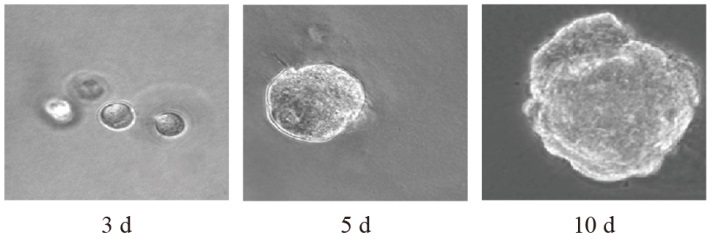
Fig. 1
T47D stem cell enrichment diagram (×400)"
Tab. 2
The effect of overexpression of miR-193a-3p on miR-193a-3p and TRIM14 mRNA expression in T47D stem cells ($\bar{x} \pm s$, n=6)"
| Group | miR-193a-3p | TRIM14 |
|---|---|---|
| Control group | 1.00±0.12 | 1.00±0.11 |
| NC mimics group | 0.98±0.10 | 0.99±0.10 |
| miR-193a-3p mimics group | 1.75±0.22ab | 0.37±0.05ab |
| miR-193a-3p mimics+pcDNA-NC group | 1.72±0.19 | 0.43±0.06 |
| miR-193a-3p mimics+pcDNA-TRIM14 group | 1.73±0.21 | 0.86±0.09cd |
| F value | 43.437 | 77.893 |
| P value | 0.000 | 0.000 |
Fig. 2
Cloning formation experiment for detecting the proliferation of T47D stem cells"
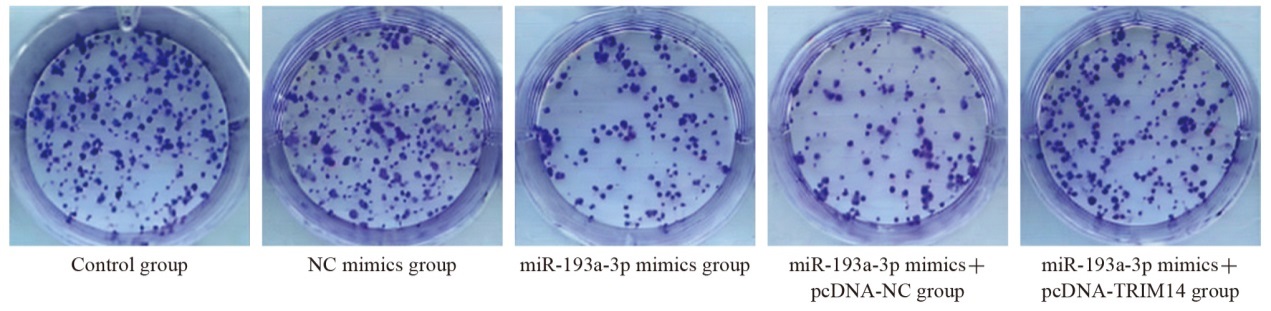
Tab. 3
The effect of overexpression of miR-193a-3p on the proliferation of T47D stem cells ($\bar{x} \pm s$, n=6)"
| Group | survival rate(%) | Number of clones (pieces) |
|---|---|---|
| Control group | 92.38±0.57 | 128.67±13.43 |
| NC mimics group | 87.52±9.25 | 127.49±13.06 |
| miR-193a-3p mimics group | 52.84±5.69ab | 67.42±7.38ab |
| miR-193a-3p mimics+pcDNA-NC group | 51.04±5.22 | 68.94±7.44 |
| miR-193a-3p mimics+pcDNA-TRIM14 group | 85.22±9.03cd | 115.82±12.34cd |
| F value | 53.552 | 46.983 |
| P value | 0.000 | 0.000 |
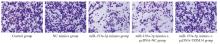
Fig. 3
Transwell experiment detects the migration of T47D cells (×200)"

Tab. 4
The effect of overexpression of miR-193a-3p on the migration of T47D stem cells ($\bar{x} \pm s$, n=6)"
| Group | Number of migrations (pieces) |
|---|---|
| Control group | 135.62±14.92 |
| NC mimics group | 136.28±14.76 |
| miR-193a-3p mimics group | 62.54±7.38ab |
| miR-193a-3p mimics+pcDNA-NC group | 64.28±7.14 |
| miR-193a-3p mimics+pcDNA-TRIM14 group | 129.63±13.57cd |
| F value | 61.448 |
| P value | 0.000 |

Fig. 4
Transwell experiment detects the invasion of T47D stem cells (×200)"

Tab. 5
The effect of overexpression of miR-193a-3p on the invasion of T47D stem cells ($\bar{x} \pm s$, n=6)"
| Group | Number of invasions (pieces) |
|---|---|
| Control group | 109.63±18.52 |
| NC mimics group | 105.62±11.27 |
| miR-193a-3p mimics group | 57.86±7.34ab |
| miR-193a-3p mimics+pcDNA-NC group | 60.24±7.59 |
| miR-193a-3p mimics+pcDNA-TRIM14 group | 95.38±10.05cd |
| F value | 27.324 |
| P value | 0.000 |
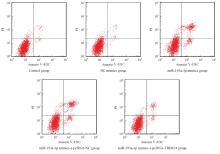
Fig. 5
Flow cytometry detection of apoptosis in T47D stem cells"
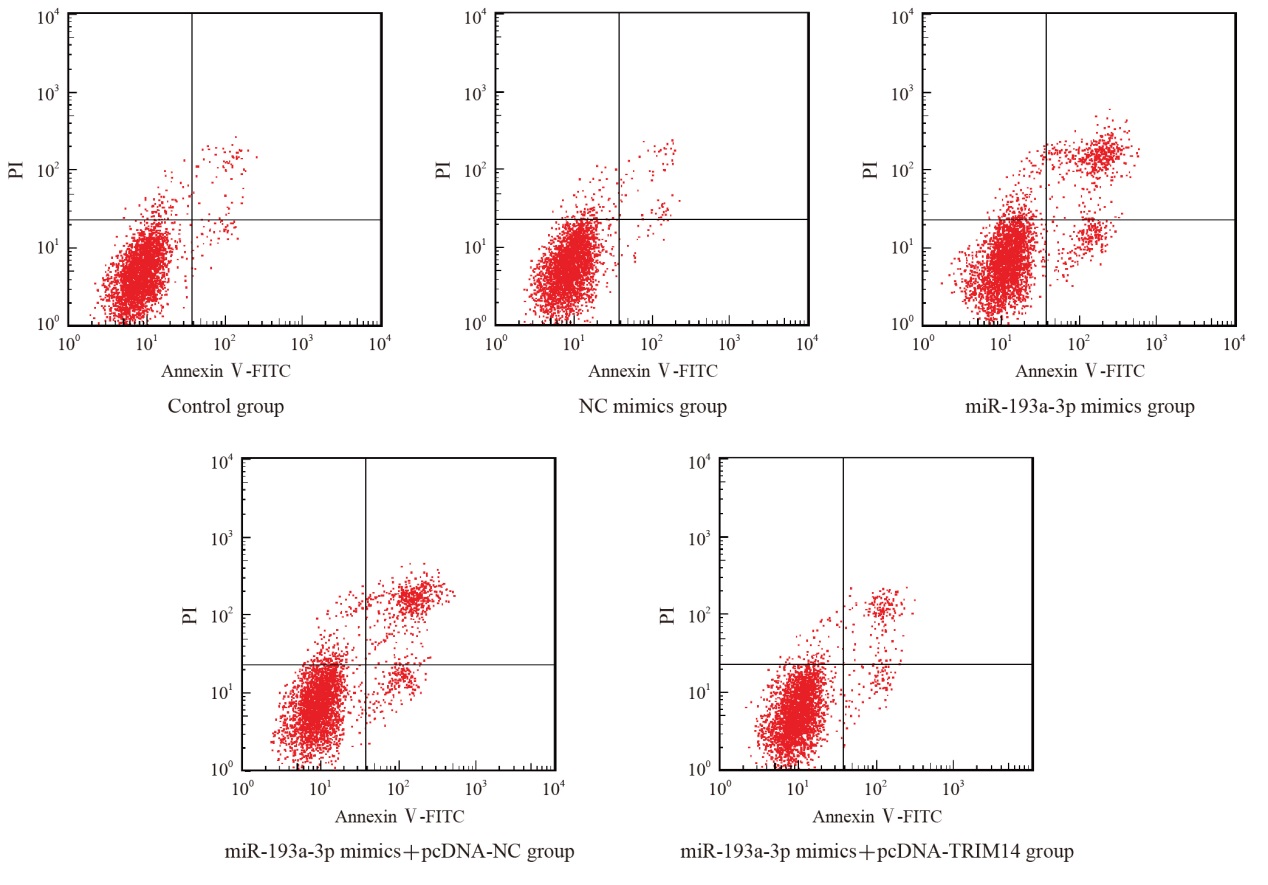
Tab. 6
The effect of overexpression of miR-193a-3p on apoptosis rate of T47D stem cells ($\bar{x} \pm s$, n=6)"
| Group | Apoptosis rate (%) |
|---|---|
| Control group | 1.69±0.25 |
| NC mimics group | 1.65±0.23 |
| miR-193a-3p mimics group | 28.06±3.07ab |
| miR-193a-3p mimics+pcDNA-NC group | 29.67±3.13 |
| miR-193a-3p mimics+pcDNA-TRIM14 group | 10.38±1.56cd |
| F value | 261.810 |
| P value | 0.000 |
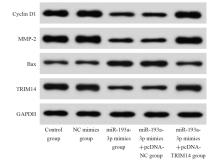
Fig. 6
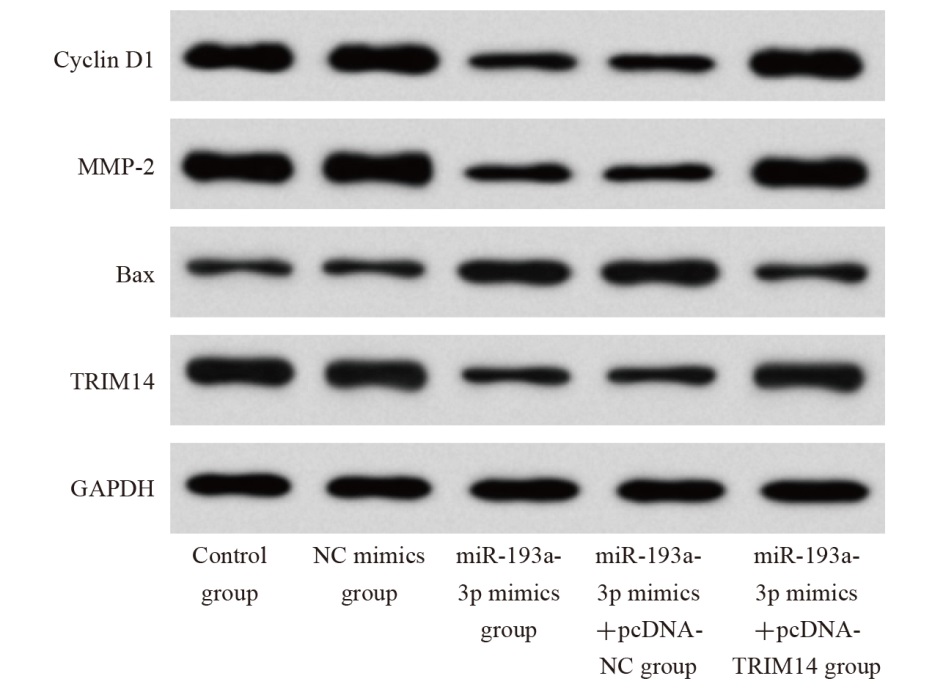
WB detection of cyclin D1, MMP-2, Bax, TRIM14 protein expression in T47D stem cells"
Tab. 7
The effect of overexpression of miR-193a-3p on the expression of cyclin D1, MMP-2, Bax, and TRIM14 proteins in T47D stem cells ($\bar{x} \pm s$, n=6)"
| Group | Cyclin D1 | MMP-2 | Bax | TRIM14 |
|---|---|---|---|---|
| Control group | 1.59±0.23 | 1.72±0.28 | 0.42±0.06 | 1.48±0.21 |
| NC mimics group | 1.62±0.24 | 1.68±0.26 | 0.43±0.07 | 1.52±0.24 |
| miR-193a-3p mimics group | 0.49±0.06ab | 0.55±0.08ab | 1.37±0.17ab | 0.56±0.07ab |
| miR-193a-3p mimics+pcDNA-NC group | 0.53±0.07 | 0.57±0.09 | 1.41±0.19 | 0.52±0.05 |
| miR-193a-3p mimics+pcDNA-TRIM14 group | 1.54±0.21cd | 1.63±0.24cd | 0.46±0.08cd | 1.43±0.18cd |
| F value | 63.758 | 51.602 | 102.529 | 56.061 |
| P value | 0.000 | 0.000 | 0.000 | 0.000 |
Tab. 8
Comparison of dual luciferase activity ($\bar{x} \pm s$, n=6)"
| Group | Dual luciferase activity | P value |
|---|---|---|
| miR-NC+TRIM14-WT group | 1.00±0.22 | — |
| miR-193a-3p mimics+TRIM14-WT group | 0.41±0.16a | 0.000 |
| miR-NC+TRIM14-MUT group | 1.03±0.23 | 0.822 |
| miR-193a-3p mimics+TRIM14-MUT group | 1.06±0.25 | 0.668 |
| [1] |
REN Y Z, BAO G S, YANG H B, et al. Ethiadin induces apoptosis and suppresses growth of MCF-7 breast cancer cells by regulating the phosphorylation of glycogen synthase kinase 3 beta (GSK3beta)[J]. Discov Med, 2022, 33(169): 55-67.
pmid: 36482736 |
| [2] | 孙静宜, 李建梅, 马英桥. circVANGL1/miR-134-5p/CDCA3轴调控乳腺癌干细胞增殖、迁移、侵袭的机制研究[J]. 临床误诊误治, 2024, 37(10): 27-34. |
| SUN J Y, LI J M, MA Y Q. circVANGL1/miR-134-5p/CDCA3 axis regulates proliferation, migration and invasion of breast cancer stem cells[J]. Clin Misdiagnosis Mistherapy, 2024, 37(10): 27-34. | |
| [3] |
CHIMPLEE S, ROYTRAKUL S, SUKRONG S, et al. Anticancer effects and molecular action of 7-α-hydroxyfrullanolide in G2/M-phase arrest and apoptosis in triple negative breast cancer cells[J]. Molecules, 2022, 27(2): 407.
doi: 10.3390/molecules27020407 |
| [4] |
STARK V A, FACEY C O B, VISWANATHAN V, et al. The role of miRNAs, miRNA clusters, and isomiRs in development of cancer stem cell populations in colorectal cancer[J]. Int J Mol Sci, 2021, 22(3): 1424.
doi: 10.3390/ijms22031424 |
| [5] | 卢鑫怡, 杜伟坡, 李景刚, 等. 血清miR-193a-3p、ATF5水平与三阴性乳腺癌患者化疗疗效的相关性[J]. 天津医药, 2024, 52(12): 1313-1316. |
| LU X Y, DU W P, LI J G, et al. Correlation between serum miR-193a-3p, ATF5 levels and chemotherapy efficacy in patients with triple negative breast cancer[J]. Tianjin Med J, 2024, 52(12): 1313-1316. | |
| [6] | 张贤雨, 马欢, 张志林. TRIM14对宫颈癌细胞增殖、迁移和侵袭及上皮—间充质转化的影响及其作用机制[J]. 广西医科大学学报, 2023, 40(1): 101-106. |
| ZHANG X Y, MA H, ZHANG Z L. Effect of TRIM14 on proliferation, migration, invasion and epithelial-to-mesenchymal transition of cervical cancer cells and its mechanism[J]. J Guangxi Med Univ, 2023, 40(1): 101-106. | |
| [7] | 张军, 吴淑宁, 陈嘉丽, 等. miR-363-5p靶向TRIM14对化疗药物诱导的乳腺癌细胞系凋亡的影响[J]. 中南医学科学杂志, 2022, 50(6): 823-827. |
| ZHANG J, WU S N, CHEN J L, et al. Effects of miR-363-5p targeting TRIM14 on chemotherapy-induced apoptosis in breast cancer cell lines[J]. Med Sci J Cent South China, 2022, 50(6): 823-827. | |
| [8] | 杨洁泉, 崔猛胜, 董文文. miR-1207-5p通过靶向LIMD1调控乳腺癌T47D干细胞的增殖、迁移和侵袭[J]. 中国肿瘤生物治疗杂志, 2021, 28(6): 567-573. |
| YANG J Q, CUI M S, DONG W W. miR-1207-5p regulates the proliferation, migration and invasion of breast cancer T47D stem cells by targeting LIMD1[J]. Chin J Cancer Biother, 2021, 28(6): 567-573. | |
| [9] |
陈安莉, 沈浩元, 阳仕雄, 等. 血浆长链非编码RNA H19对乳腺癌新辅助治疗效果的预测价值[J]. 中国癌症杂志, 2022, 32(8): 727-735.
doi: 10.19401/j.cnki.1007-3639.2022.08.008 |
|
CHEN A L, SHEN H Y, YANG S X, et al. Predictive value of plasma long non-coding RNA H19 in neoadjuvant therapy for breast cancer[J]. Chin Oncol, 2022, 32(8): 727-735.
doi: 10.19401/j.cnki.1007-3639.2022.08.008 |
|
| [10] |
WANG H, CHEN X, JIN Y S, et al. The role of DYNLT3 in breast cancer proliferation, migration, and invasion via epithelial-to-mesenchymal transition[J]. Cancer Med, 2023, 12(14): 15289-15303.
doi: 10.1002/cam4.v12.14 |
| [11] |
YANG H S, WANG Z W, HU S, et al. miRNA-874-3p inhibits the migration, invasion and proliferation of breast cancer cells by targeting VDAC1[J]. Aging, 2023, 15(3): 705-717.
doi: 10.18632/aging.v15i3 |
| [12] |
Barbagallo D, Ponti D, Bassani B, et al. MiR-223-3p in cancer development and cancer drug resistance: same coin, different faces[J]. Int J Mol Sci. 2024, 25(15):8191-8203.
doi: 10.3390/ijms25158191 |
| [13] | WU J P, ZHANG G Y, SUN X Z. LncRNA ZNFX1-AS1 targeting miR-193a-3p/SDC1 regulates cell proliferation, migration and invasion of bladder cancer cells[J]. Eur Rev Med Pharmacol Sci, 2020, 24(9): 4719-4728. |
| [14] |
YANG X P, ZHENG Y Z, TAN J, et al. Circ_0020123 regulates autophagy, glycolysis, and malignancy by upregulating IRF4 through eliminating miR-193a-3p-mediated suppression of IRF4 in non-small cell lung cancer[J]. Neoplasma, 2022, 69(2): 392-403.
doi: 10.4149/neo_2022_211013N1449 |
| [15] | XIE S D, QIN C, JIN L D, et al. Long noncoding RNA SNHG14 promotes breast cancer cell proliferation and invasion via sponging miR-193a-3p[J]. Eur Rev Med Pharmacol Sci, 2020, 24(14): 7543. |
| [16] |
JING X, DU L T, SHI S, et al. Hypoxia-induced upregulation of lncRNA ELFN1-AS1 promotes colon cancer growth and metastasis through targeting TRIM14 via sponging miR-191-5p[J]. Front Pharmacol, 2022, 13: 806682.
doi: 10.3389/fphar.2022.806682 |
| [17] |
CHEN Q, ZHOU L, MA D, et al. LncRNA GAS6-AS1 facilitates tumorigenesis and metastasis of colorectal cancer by regulating TRIM14 through miR-370-3p/miR-1296-5p and FUS[J]. J Transl Med, 2022, 20(1): 356.
doi: 10.1186/s12967-022-03550-0 pmid: 35962353 |
| [18] |
XIAO F, OUYANG B S, ZOU J, et al. Trim14 promotes autophagy and chemotherapy resistance of gastric cancer cells by regulating AMPK/mTOR pathway[J]. Drug Dev Res, 2020, 81(5): 544-550.
doi: 10.1002/ddr.v81.5 |
| [19] |
XIE F, XIONG Y Y, YAN J Y, et al. Circular RNA circ_0048764 promotes the development of breast cancer by regulating microRNA-1296-5p/tripartite motif containing 14 axis[J]. Bioengineered, 2022, 13(2): 1963-1974.
doi: 10.1080/21655979.2021.1995990 |
| Viewed | ||||||
|
Full text |
|
|||||
|
Abstract |
|
|||||
沪ICP备12009617
Powered by Beijing Magtech Co. Ltd

